
Measure Signal, Not Applause
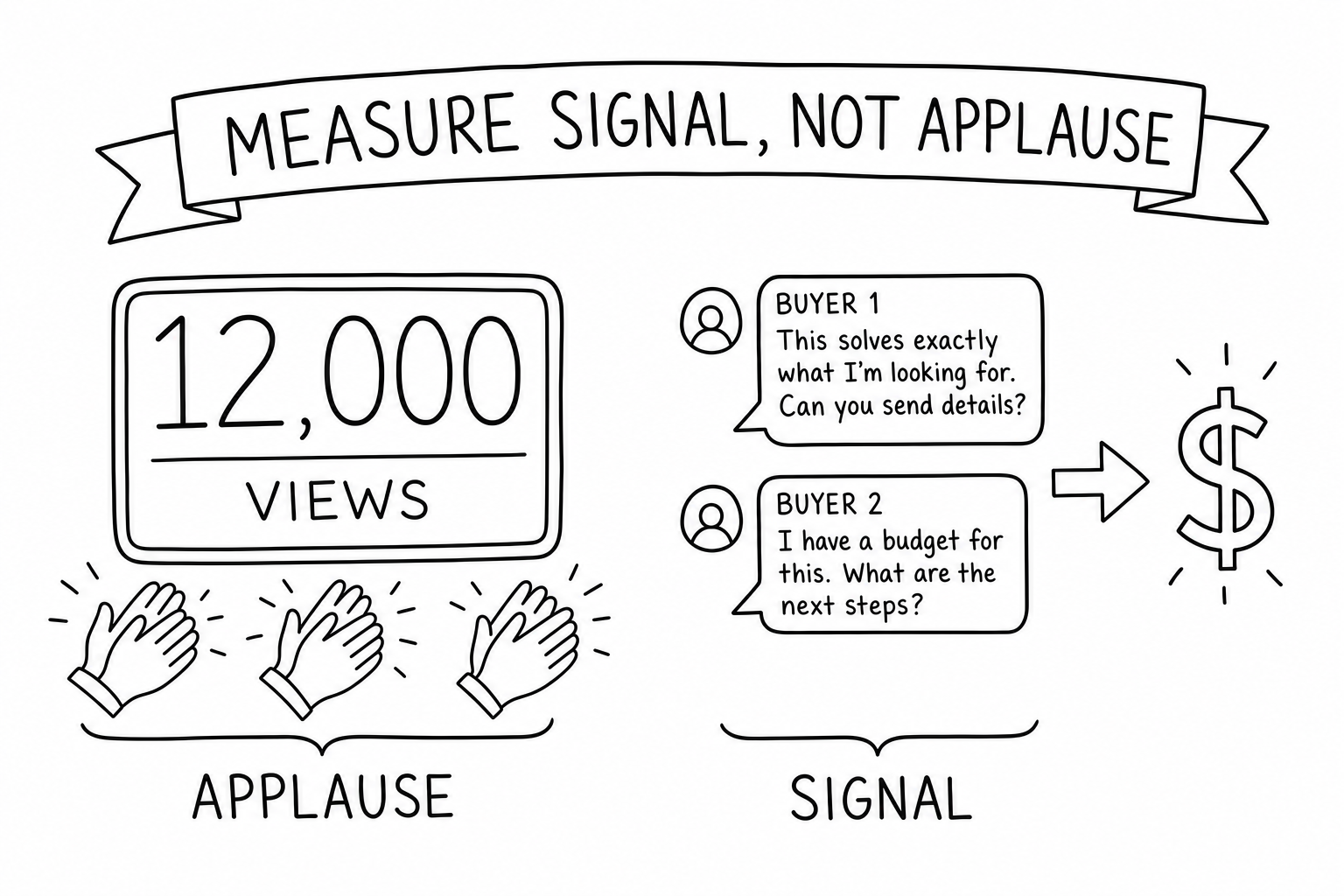
One post gets 12,000 views.
People like it. A few strangers leave comments. The graph looks good, which means the day feels good.
Another post gets 700 views and two messages from buyers who describe the exact problem you solve.
The second post is probably more valuable.
The platform will not tell you that clearly. You have to decide what signal means before the numbers start performing for your ego.
Applause Is Not Useless
Reach, likes, shares, and followers can matter.
They tell you whether the platform is distributing the content. They can create social proof. They can help discovery. They can show that a hook or format has energy.
But applause gets dangerous when you use it as the main score for every platform job.
If your platform job is trust, a smaller post read by the right buyers may matter more than a viral post read by everyone else.
If the job is traffic, clicks and downstream behavior matter more than comments.
If the job is community, replies from repeat members matter more than public likes.
If the job is proof, prospects mentioning a post on sales calls matters more than the post's reach.
The metric has to match the job.
The Signal Stack
Use five signal categories.
This keeps the review practical.
This is not an analytics-team workload. It is a way to stop being fooled by the easiest number to screenshot.
Use the Scorecard
The scorecard gives you a decision, not a dopamine hit.
Read the Combination, Not One Number
The useful part is the pattern across scores.
High relevance and low movement usually means the idea attracted real buyers, but the next step was weak. Fix the profile, CTA, link, or offer-adjacent bridge before blaming the topic.
High movement and low relevance usually means the hook worked on the wrong crowd. Tighten the audience language and stop using broad hooks that invite everyone.
High learning and low applause can still be valuable. A quiet post that reveals the exact objection buyers have may become a sales page section, an email, or a better offer explanation.
High consistency and low everything else means the machine runs, but the material needs work. Keep the rhythm and repair the ideas.
Low consistency makes the rest hard to read. Fix the cadence first.
This is why the scorecard uses five categories. One number lies easily. A pattern is harder to fool.
High reach with low relevance is a warning. The post traveled, but maybe to the wrong people.
Low reach with high depth is a clue. The format might need better packaging, but the idea matters.
High relevance and low depth means the audience is right, but the post may be too obvious. Add sharper examples, proof, or a clearer point of view before repeating it.
Review Posts by Role
Do not compare every post against every other post.
Compare education against education. Proof against proof. Personality against personality. Offer-adjacent against offer-adjacent.
An education post may get saves and comments.
A proof post may get fewer public comments and more profile visits.
An offer-adjacent post may get fewer likes and better DMs.
If you compare them all by likes, the content mix will drift toward whatever gets easy applause. That usually means broad opinions, jokes, controversy, or polished inspiration.
Those can work.
They just might not support the business.
Keep a Signal Log
Do not rely on memory.
Create a simple note with three sections:
Exact phrases people used in comments or DMs
Questions that came up more than once
Posts that created clicks, saves, replies, or qualified conversations
The language is the asset.
If three people describe the problem with the same phrase, that phrase belongs in future posts, profile copy, emails, sales pages, or offers. Social becomes more useful when it feeds everything else the business is doing.
Monthly Review
Once per month, review the system.
Use this order:
Did we publish the cadence we chose?
Which post role created the best signal?
Which topic got the right people to respond?
Which format was easiest to repeat?
Which metric looked impressive but did not matter?
What will we repeat next month?
What will we stop doing next month?
Keep the review boring.
Boring reviews produce better decisions because they stop you from reinventing the system every time the graph moves.
When You Move Too Fast
Measurement fails when you change the plan too quickly.
Four posts are not a strategy sample. Two weeks of quiet is not proof a platform is dead. One viral post is not proof you found the answer.
The first 30 days tell you whether the system is executable and where the early signal appears.
The first 90 days tell you whether the channel deserves more effort, a different content mix, or a clean pause.
If you need revenue next week, social organic is probably the wrong lever. Use direct outreach, partnerships, paid traffic, referrals, or sales follow-up. Organic social is usually a compounding channel, a trust surface, or a discovery engine.
Ask it to do the right job.
Score Three Posts
Pick three recent posts. Score each one on relevance, depth, movement, learning, and consistency in the scorecard above. Then record one decision for each, so the calls persist into next month's review instead of evaporating.
Three posts scored, one decision each
For each post: total score out of 25, then one call — repeat, repackage, retire, test again with a clearer hook, or connect to a stronger profile or offer.
Platform choice, profile promise, content mix, and scorecard are four working pieces. They only become a system once they sit on one page and run for a quarter — which is the last thing you build.
So cap it there, and let the rule that keeps the system honest be the smallest number in this lesson. Maximum monthly changes: 2.
Sources
HubSpot — 2025 Social Media Marketing Report. Used for current social performance context and tying social to business outcomes.
Hootsuite — Social Media Calendar. Used for consistency and review discipline.
Sprout Social — Social Media Marketing for Small Business: Complete Guide for 2026. Used for goal-setting and measurement framing.
Fayne Marketing Wiki — Social cadence and focus evidence pages. Used for the monthly review and signal-over-noise framing.