
You open a client's brand workspace and find five social accounts waiting for you.
LinkedIn has two decent posts from last quarter. Instagram has a bio that could belong to any business in the country. TikTok has three videos, all made during one burst of optimism. Facebook still has the old logo. YouTube has a banner image and no uploads.
Nothing is broken.
That is the problem.
Every account is just alive enough to create guilt. Every channel looks like an opportunity someone is wasting, and the client can see all five in the same review. So the obvious answer seems to be more effort: post more, schedule more, repurpose more, finally get organized.
That answer is how the mess gets bigger.
If you plan and approve content in Kontentino, you already see this laid out in front of you: one calendar, five channels, and a week that only has room for two of them done properly. This course is about choosing which two, on purpose, and being able to defend the choice to the client.
The Hidden Cost
Platform sprawl is what happens when a business treats social media like attendance.
If the platform exists, the business thinks it should show up.
That sounds responsible until you add the real cost:
different formats
different norms
different captions
different posting rhythms
different comments to answer
different metrics to interpret
Five platforms are not five copies of the same job. They are five jobs.
You can use the same idea in more than one place, but you cannot use the same operating system everywhere and expect the same result. A thoughtful LinkedIn post often dies as an Instagram caption. A useful YouTube tutorial cannot be squeezed into TikTok by cutting it into random clips. A local Facebook community post may look painfully boring on X and work perfectly for the people who need it.
That is why "just cross-post it" rarely fixes the problem.
It moves the work.
Focus Is a Business Decision
The point of focus is not aesthetic. It is operational.
When you choose one primary platform, four things get easier:
Focus gives you enough repetition to learn what works.
You see patterns faster because the inputs are cleaner. You learn which hooks get the right comments, which post types create saves, which topics bring good DMs, and which ideas only produce empty reach.
Spread the same effort across five platforms and every signal gets weaker. A quiet post might mean the idea was wrong, the format was wrong, the platform was wrong, the timing was wrong, or the account was too inconsistent to have a fair test.
You cannot diagnose that cleanly.
You just feel behind.
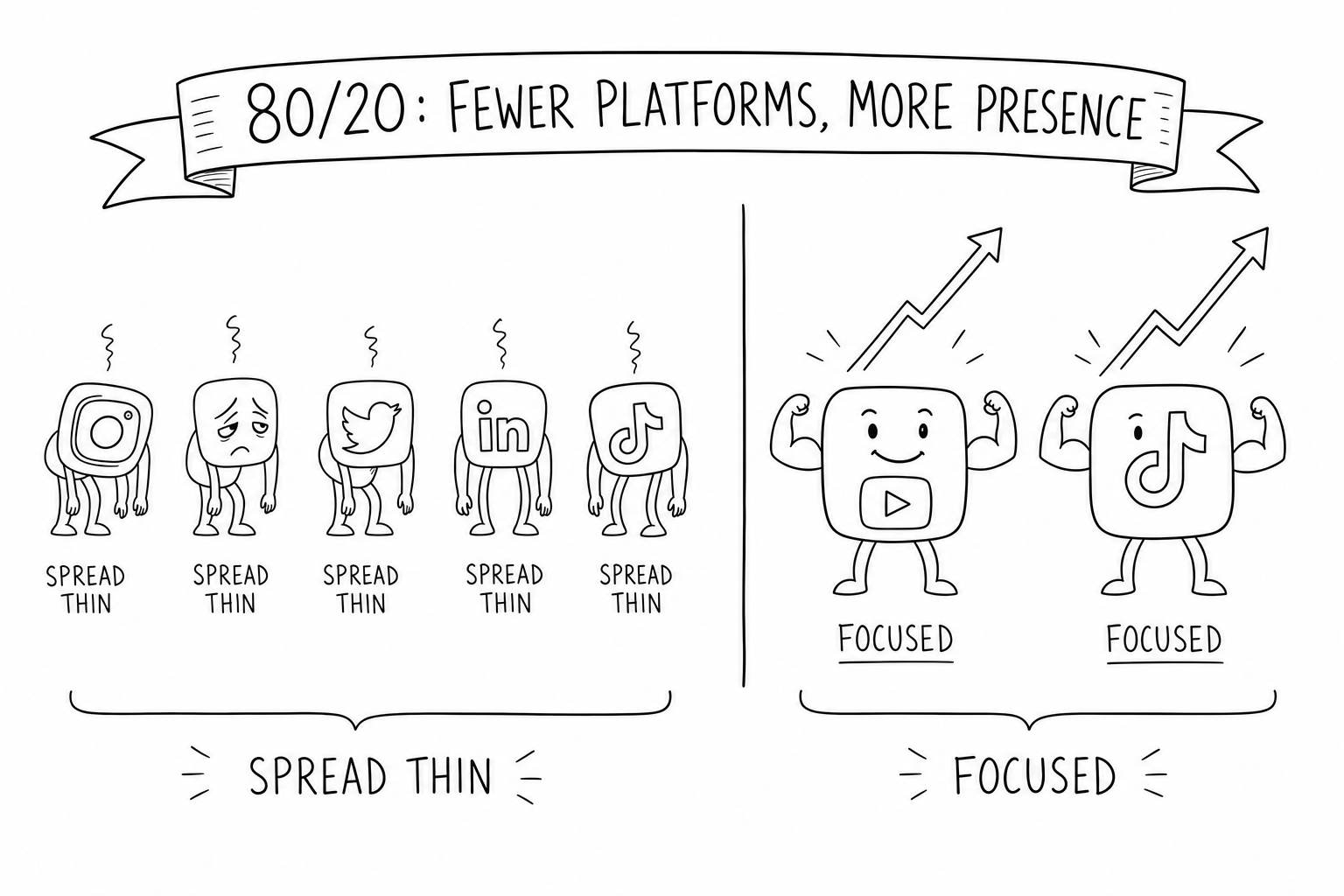
The 80/20 Rule for Social
The useful 20% of social media usually comes from a small set of choices:
One audience you care about reaching
One business goal social should support
One primary platform where that audience already spends attention
One content format your team can make consistently
One review rhythm that tells you whether the work is helping
That is the course.
The goal here is not omnipresence. It is a focused social footprint that compounds.
This is especially true for small teams. A brand with a full in-house content studio can run native strategies across six channels. A two-person social team, or an agency pod carrying six client accounts at once, usually cannot.
The honest plan beats the impressive one.
The Wrong Kind of Presence
There is a kind of social presence that looks good from far away.
Every icon is in the footer. Every account has a profile photo. Every platform has a few posts. The brand seems active.
Then you click through.
The last Facebook post is from eight months ago. The Instagram grid has no clear audience. The LinkedIn company page shares generic articles. The TikTok account has no rhythm. The YouTube channel has one explainer video that took three weeks and never got a second episode.
That is a museum of abandoned intentions, not a social strategy.
An agency runs five accounts for a client. All are lightly active, none generate conversations. What is the real problem?
The accounts need more frequent posting
The accounts need better-looking graphics
The effort is split too thin to produce a clean signal anywhere
The agency picked the wrong platforms
A smaller footprint can look less impressive in a slide deck and work better in real life.
One strong LinkedIn page with a clear promise, two posts per week, comments from actual buyers, and a monthly review will beat five neglected accounts for most B2B clients.
One useful Instagram account with proof, local trust, and clear calls to action will beat a dozen half-hearted cross-posts for most local or visual brands.
One YouTube channel with durable search-led tutorials can beat daily short posts for an expert whose buyers need depth before they trust.
The answer depends on the business.
The pattern does not.
The Audit That Changes the Conversation
Before you pick anything, write down what each account currently costs.
Not money. Attention.
For each platform, note the real work:
What format does this platform need?
Who has to make that format?
How often does the account need attention?
What comments, DMs, or messages need replies?
What business outcome would make this worth keeping?
This turns the platform list from a brand-presence fantasy into an operating list.
That is when the decision gets easier. A neglected Instagram account stops being "we should post more" and becomes "two visual proof posts a week, a named person on DMs, an approval step that clears in a day, and a profile that points to booking."
A quiet YouTube channel stops being "we should make videos" and becomes "we need one durable tutorial per month and a clear reason to invest four hours."
Some accounts will survive that audit.
Many will not.
What You Are Allowed to Ignore
You are allowed to ignore platforms where your audience is weak.
You are allowed to ignore formats your team cannot make well.
You are allowed to ignore metrics that do not connect to the business goal.
You are allowed to ignore trends that would create a second job without creating a better outcome.
This is the part that feels uncomfortable. Social media is public, so skipping a platform can feel like disappearing. But the people who matter rarely judge your business by whether you have every icon filled in.
They judge by whether the few surfaces they touch are clear, useful, alive, and trustworthy.
When Focus Fails
Focus fails when you use it as an excuse to disappear.
Picking one platform does not mean posting once, waiting for applause, and declaring the channel dead. A focused platform still needs a real test.
For this course, a real test means:
a clear platform choice
a clear profile promise
a repeatable content mix
a realistic cadence
a 30-day review
a 90-day commitment before major judgment
If you cannot give a channel that much, you have not chosen it. You have sampled it.
Sampling is fine.
Just do not call it strategy.
Try this first
Open every social account tied to the brand you run, or to your biggest client. Put them in three columns: active, neglected, and dead.
Do not fix anything yet. Do not post. Do not rewrite the bio.
Just count the obligations.
Then fill in the one sentence that turns the whole list into a decision. The blank is the move. Once it is filled, every platform can be scored against it instead of guessed at.
Finish the sentence: "For the next 90 days, social media needs to help this brand with ______." One outcome, not three.
Write that sentence now, before you score a single platform. Keep it in front of you every time a new platform tempts you.
Sources
Buffer — How Many Social Media Platforms Should a Small Business Use? Used for the focus principle and the warning against spreading a small team too thin.
Hootsuite — Social Media Calendar. Used for the emphasis on realistic calendar discipline and consistent publishing.
Fayne Marketing Wiki — Social focus beats platform sprawl; Two good social channels beat five neglected ones. Used for the core platform-sprawl framing.
Sprout Social — Social Media Marketing for Small Business: Complete Guide for 2026. Used for lean-team strategy and operational constraints.