
Build the Four-Post Mix
The calendar is empty again.
This is where social systems usually die. Not because the business has no ideas. Because the ideas are loose.
Loose ideas ask you to invent the whole plan every week.
Repeatable formats do something better. They turn the blank calendar into a set of slots.
The Four Posts
Your social system needs four content roles.
Post types are easier to repeat than post ideas.
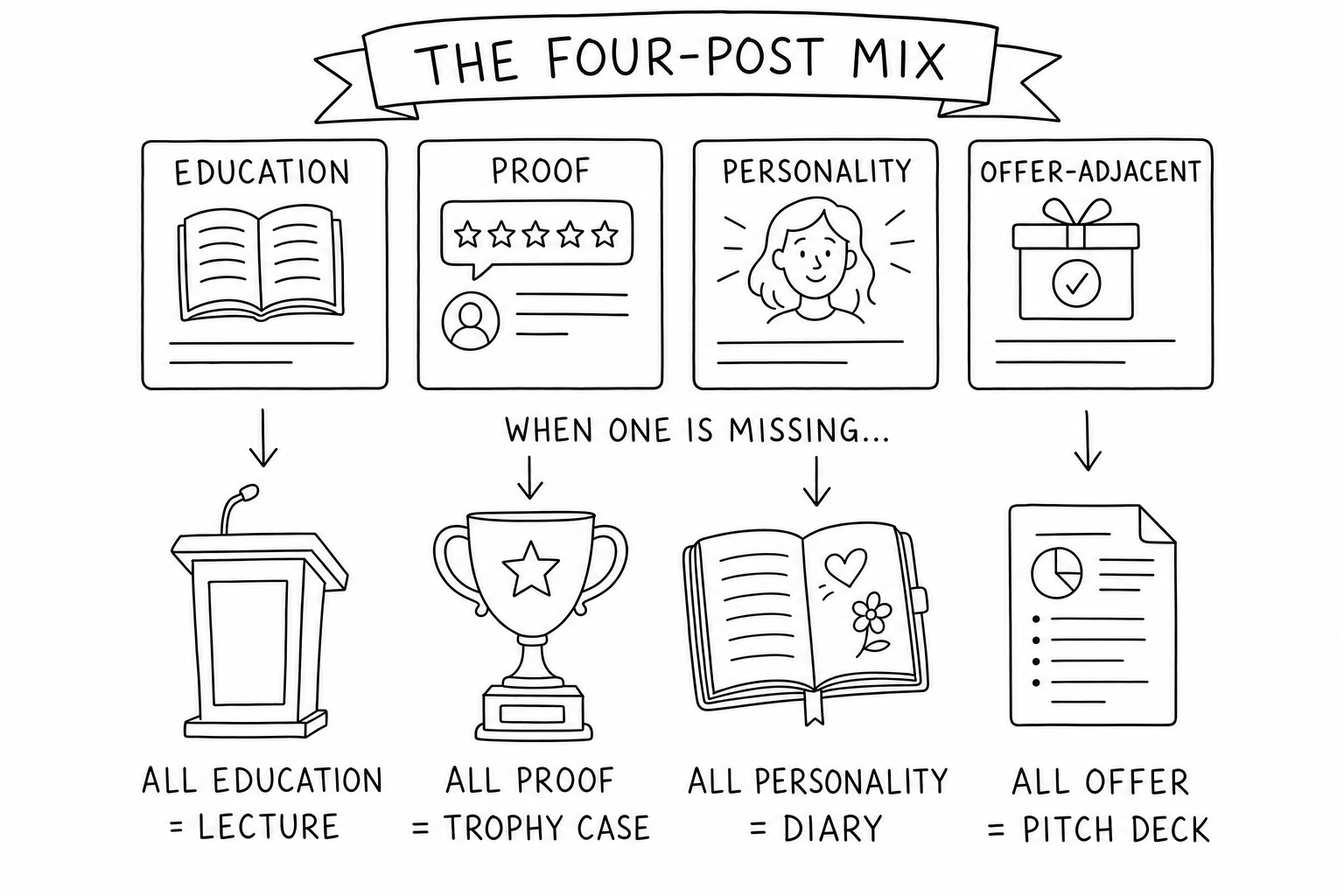
The four roles are:
education
proof
personality
offer-adjacent
Equal amounts are not the goal. All four roles in the system, in some balance, are. Without them, the account becomes a lecture, a trophy case, a diary, or a pitch deck.
Education
Education posts help your audience make a better decision.
They can be short lessons, mistakes, checklists, before-and-after explanations, teardown threads, carousels, clips, tutorials, or answers to common questions.
Good education posts do one small job.
Bad ones try to teach the whole field.
For a web designer:
weak: "Why good design matters"
stronger: "Three homepage sections to fix before you buy more traffic"
For a real estate agent:
weak: "Market update"
stronger: "What a $40,000 price cut actually means for a buyer"
For a coach:
weak: "Leadership tips"
stronger: "The sentence that turns a vague one-on-one into a real conversation"
Education builds trust because it shows judgment.
Proof
Proof posts show that the promise is real.
They include client results, customer stories, before-and-after work, process receipts, screenshots, testimonials, portfolio pieces, reviews, lessons from delivery, and specific examples.
Proof does not have to mean bragging.
It can be quiet:
"Here is the messy first draft before the final page."
"Here is the question that changed the sales call."
"Here is the inspection issue we caught before closing."
"Here is the menu change that made ordering simpler."
Proof works when it helps the buyer believe the business can do the job.
Personality
Personality posts give the account a human edge.
This does not mean oversharing. It means showing taste, values, context, point of view, and the occasional ordinary detail that makes the account feel run by a person.
For a founder-led business, personality might be:
a belief about the industry
a lesson learned from a client project
a behind-the-scenes decision
a mistake and what changed
a small story about how the work gets done
For a brand account, personality might be:
the team's standards
customer language
rituals
local context
founder POV
Personality fails when it becomes content about the creator's mood with no connection to the audience.
General interestingness is not the target.
Being memorable to the buyers you want is.
Offer-Adjacent
Offer-adjacent posts move people closer to buying without yelling at them.
They explain the problem your offer solves, who it is for, when it makes sense, when it does not, what happens before buying, what happens after buying, what objections are normal, and what next step is available.
Examples:
"When a landing page audit makes sense"
"Who should not book this call"
"What happens after you request a quote"
"Three signs your content problem is actually a positioning problem"
"How to know whether you need the full service or the template"
These posts matter because social accounts often avoid selling until they panic. Then they publish one awkward direct pitch and disappear.
Offer-adjacent content keeps the sales conversation warm.
An account posts only client wins and testimonials, week after week. Which role is missing, and what does the account start to feel like?
Education is missing — it feels like a sales pitch
It is over-weighted to proof — it feels like a trophy case with no judgment or human edge
Offer-adjacent is missing — it feels too soft
Nothing is missing — proof is the only role that converts
Build Your Weekly Mix
Start with two posts per week if capacity is low.
That is enough to learn if the posts are good and the review rhythm is real.
Pick the smallest cadence you can keep on a bad week:
Cadence | Days and roles |
|---|---|
Two-post week | Tue: education · Thu: proof or offer-adjacent |
Three-post week | Mon: education · Wed: proof · Fri: personality or offer-adjacent |
Four-post week | Mon: education · Tue: proof · Thu: education or personality · Fri: offer-adjacent |
Do not copy these days blindly. The rhythm matters more than the calendar labels.
Pick a cadence you can keep on a bad week.
Turn One Idea Into Four Formats
Take one topic: "Why your website is not converting."
Education:
"Three homepage mistakes that make visitors hesitate."
Proof:
"Before and after: how one clearer hero section changed the page."
Personality:
"The redesign mistake I kept making when I cared more about polish than clarity."
Offer-adjacent:
"When to book a conversion audit instead of redesigning the whole site."
Same topic. Four roles.
This is how the system stays coherent without becoming repetitive.
Build a Small Format Library
A post role is the job. A format is the container.
You need both.
For education, useful starter formats include:
mistake and fix
three signs
before and after
one question to ask
short teardown
For proof:
client result
process breakdown
review with context
project before and after
lesson from delivery
For personality:
belief about the market
behind-the-scenes decision
standard you refuse to lower
mistake you corrected
small story from the work
For offer-adjacent:
who this is for
who this is not for
when to buy
when to wait
what happens after inquiry
Pick two formats per role. That gives you eight repeatable containers.
Eight is plenty.
Batch by Role, Not by Platform
When you sit down to create, batch one role at a time.
Write three education posts in one sitting. Then two proof posts. Then one offer-adjacent post. This is easier than switching from a tutorial to a customer story to a sales explanation every fifteen minutes.
Role batching keeps your brain in one mode.
It also makes repurposing cleaner. One education post can become a LinkedIn post, carousel outline, short video script, newsletter section, or FAQ answer. One proof post can become a story, pinned post, case-study intro, sales-call follow-up, or website section.
The goal is not to squeeze every idea into every possible format.
The goal is to stop starting from zero.
If a post works, repackage it. If a post teaches you useful language, save it. If a proof point earns attention from real buyers, turn it into a stronger asset.
Your content library should get easier to use every month.
Translate, Do Not Repost
If you chose a secondary platform, translate the idea before you publish it there.
The same idea can travel. The same post usually should not.
LinkedIn post becomes an Instagram carousel with one clear cover.
YouTube tutorial becomes three short clips, each with one lesson.
Client story becomes a Facebook post with local context.
Newsletter section becomes a Threads conversation starter.
Long LinkedIn post pasted into Instagram caption.
YouTube clip posted without context or hook.
Testimonial screenshot dropped everywhere with the same caption.
Blog link posted with "new post is live."
Translation respects the platform without creating a brand-new strategy. That is the sweet spot for a secondary channel.
Use one idea. Change the wrapper.
Three Filled-In Mixes
Here is the four-post mix with actual businesses.
For a B2B marketing agency:
Role | Example |
|---|---|
Education | "The homepage section most SaaS founders write too early" |
Proof | "Before and after: the offer block we rewrote for a demo page" |
Personality | "The conversion advice the team stopped giving after 12 audits" |
Offer-adjacent | "When a landing page audit is enough, and when the offer needs work" |
For a kitchen remodeler:
Role | Example |
|---|---|
Education | "Three cabinet decisions that change the budget fast" |
Proof | "The before-and-after that shows why layout beat new finishes" |
Personality | "The material choice the team will talk you out of" |
Offer-adjacent | "What happens in the first walkthrough" |
For a career coach:
Role | Example |
|---|---|
Education | "The sentence that makes a vague one-on-one useful" |
Proof | "A client turned a tense review into a promotion path" |
Personality | "Why the team avoids scripts that sound like scripts" |
Offer-adjacent | "Who should book a coaching call before their next review" |
You can feel the difference.
The structure stays the same. The market changes the examples.
When the Mix Becomes a Quota
The four-post mix fails when the categories become boxes to fill instead of jobs to perform.
Do not publish a "personality post" just because Friday arrived. Do not invent fake proof. Do not force an offer post when there is no useful buying context to explain.
The mix is a planning tool, not a quota.
If you only have two good posts this week, publish two good posts.
The audience will survive.
Build Your First Four
Pick one problem your audience cares about. Write four post titles from it, one per role. The field below keeps them, so the first week of the system is already drafted before you leave this lesson.
Your first four post titles
One audience problem, four roles: Education, Proof, Personality, Offer-adjacent. Titles, not paragraphs.
Then choose your starter cadence for the next four weeks. Keep it small enough that you can execute while everything else in the business keeps happening.
Posts will start landing. Some will look loud and mean little. So here is the question that decides whether this system helps the business or just feeds the graph: when a post gets 12,000 views and another gets 700, which one would you actually want more of?
Sources
HubSpot — Content Pillars for Social Media. Used for the repeatable pillar and planning logic.
Fayne Marketing Wiki — Social Post Mix: Education, Proof, Personality, Offer. Used for the four-role content mix.
Hootsuite — Social Media Calendar. Used for calendar discipline and sustainable posting rhythm.
HeyOrca — Optimal Social Media Posting Frequency by Platform 2026. Used for current cadence context and practitioner disagreement around frequency.