
The Secondary Channel Test
The test sits at the point where a request stops being cheap. Everything before that point is a conversation. Everything after it is a line in somebody's budget.
New channels arrive dressed as ambition, and audience size is the wrong first question. A large audience on a feed you cannot keep fed is the same problem you already have, at a bigger scale.
A channel is secondary when work you already do makes its assets. Everything else is a second primary.
So this lesson runs three questions, puts a price against each one, and names the two ways a channel passes the test and still dies four months later.
Ask where the asset comes from
Start with the asset rather than the audience. Does work your team already produces turn into a post here, or does this channel have to make something of its own before anything goes out at all?
That one question splits the request into two prices nowhere near each other. One of them fits inside a Tuesday afternoon. The other needs a diary, a budget line and somebody who can cut vertical video.
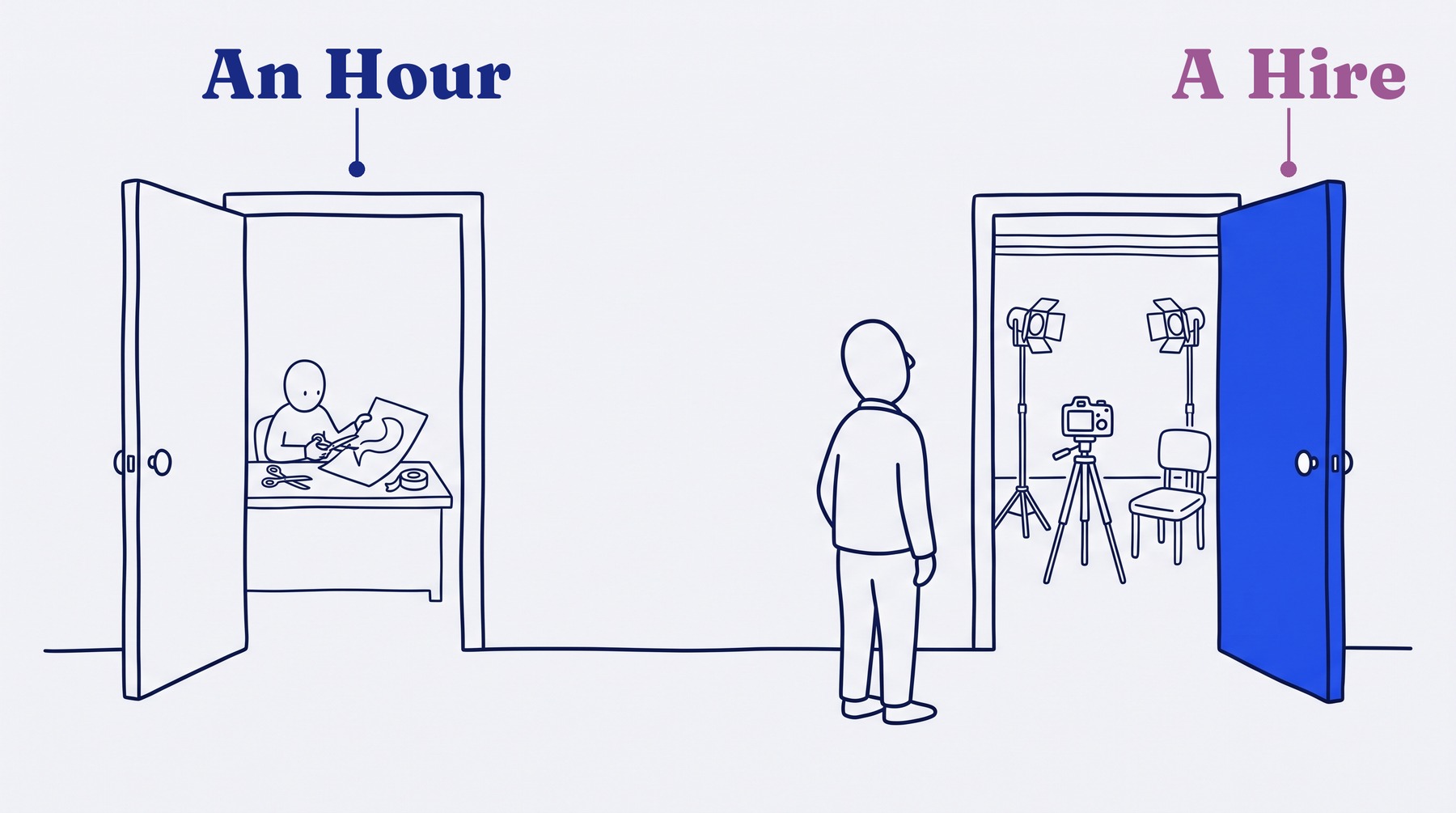
Both rooms answer the same request. One is an afternoon at a desk. The other is a room nobody has been hired to stand in yet.
An hour or a person
A translation is one idea reshaped for a feed that reads differently. The argument has already been made and already approved. What gets redone is the packaging around it.
A second primary needs its own shoot, its own editor, or a weekly minimum of its own. Any one of those turns a request into a hire, and none of the three arrive by being asked nicely on a call.
Where the asset comes from. Existing work makes it, or this channel makes it alone.
What weekly floor it needs. A lower one than your primary carries, or a full one of its own.
Who edits it. Somebody already on the account, or somebody hired to cut for this feed.
Any single one of those three settles the question on its own. Read them as prices rather than as opinions, because each answer on the right hand side has a person or a shoot day standing behind it.
The left column is an hour of somebody's Tuesday. The right column is a person, a diary and a line on next year's budget, and the request usually arrives sounding like the left one.
What the hour actually buys
Say Tuesday's LinkedIn post argues that a client's onboarding email loses people at step two. The Instagram version is that same argument at a different shape.
The thinking gets reused. Only the packaging gets redone, and packaging is the cheaper half.
You pull the three lines that carry it, set them over the screenshot the post already used, rewrite the opening so it works with nothing above it, and cut the sign-off that only reads on LinkedIn. Forty minutes when the screenshot exists, ninety when somebody has to build one.
Price the step before you agree
Those three questions are worth asking before anybody says yes. Afterwards the answer belongs to whoever ends up doing the work, and they discover the price on a Thursday with the shoot already booked.
Work you already do makes it, or this channel makes it alone. One answer costs an hour. The other costs a hire.
An hour or a person. Say which before you agree to anything, because afterwards the answer stops being yours.
A secondary still needs a minimum week. Smaller than a primary's, and still a number. Write it down now, because it is what you will be defending in four months.
Requests fail at the first step, quietly, because nobody asks until a shoot day is already in a diary. Naming the source costs one sentence, and it is the cheapest sentence in the whole exchange.
Where the test still lets one through
A channel can pass all three questions cleanly and die anyway. Two ways, and both of them sit outside the questions themselves.
The other way is ownership. A translation that passes every question still dies when nobody holds the hour, because an hour with no name against it is the first thing a busy week drops.
One condition sits above all three. A secondary earns its hour on top of a primary that already clears its own minimum, so a starving primary plus a new channel gives you two starving channels and a harder conversation in April.
Call it a discount on work you are already doing. The discount is real, and it is smaller than the request usually implies.
Where these numbers come from
The forty and ninety minute figures are the working range for a translation on a team that already holds its own source material, and they are this course's own framework rather than a measurement taken from anywhere else. Time one properly on your own account before you quote it, because a screenshot that has to be built moves the number more than anything else in the job. Nothing in this lesson is a claim about any tool or any client.