
The Capacity Board
How many channels can six finished assets a week actually carry? The answer is arithmetic, and the arithmetic only works once somebody writes down the two numbers it runs on.
The first number is what your team finishes in a normal week. The second is what each channel needs before it returns anything. Neither number is usually written anywhere.
A capacity argument stops being a feeling the moment both numbers are on a board the client can open.
So this lesson produces the two numbers off your own accounts, allocates them in the only order that holds, and shows you the one thing that makes the board argue back.
Count the week before you argue about it
Take what shipped last month and divide it by four, including the weeks somebody was away. The number you count is almost never the number in the proposal, and counting it anyway is the entire point of the exercise.

One week row in the calendar, holding what that week actually carries. Count that, then argue.
That is a countable week, sitting in a view the client can open for themselves. It stops being your opinion the moment they can reach it without asking you.
What counts as finished
The count only means something once everybody agrees what a finished asset is, so settle that before you show anybody the board. Three lines cover it. None of them are controversial once somebody writes them down.
What actually left the building in a normal week, holiday weeks included.
Ideas and drafts that still need somebody's approval stay out of the count.
The figure a client could reach on their own, off a calendar you both have access to.
Ideas and drafts are real work, and they are invisible from outside. The count is what left the building, because that is the only part anybody on the client side can see.
Every channel on that board also needs a number of its own before the division means anything. Yours is buried in eight weeks of that channel's own history, and three steps get it out.
One channel at a time. Beside each week put the posts that went out, and what came back that a client would care about.
Replies from buyers. Saves. Visits to the profile from job titles you sell into. Follower growth stays off the list, because it moves for reasons nobody in the room controls.
Say the empty weeks run up to two posts, and the weeks with three brought back two real replies. The floor is three.
A channel that has never once run above its floor has none you can read yet, so give it a fair run before you try to read anything off it. Everything else on this board comes off numbers you already own and can show somebody.
Floors come out first
Dividing the week evenly is what makes a board lie. Every channel gets a share that looks fair on the slide, and three of them land under the line where anything comes back.
Primaries take their floors first, in order. Whatever the week has left over is what the secondary runs on, and a translation takes one asset rather than a third of everything.
The order you allocate in decides who starves. The size of the week only decides how many survive it.
Floors of three and two, plus a secondary at one, fills a week of six exactly. Nothing is left spare and nothing is starved, which is the state you are aiming at.
Now add a third primary with a floor of three. The sum is eight and the week is still six, so two channels drop under their line before anybody has argued about anything.
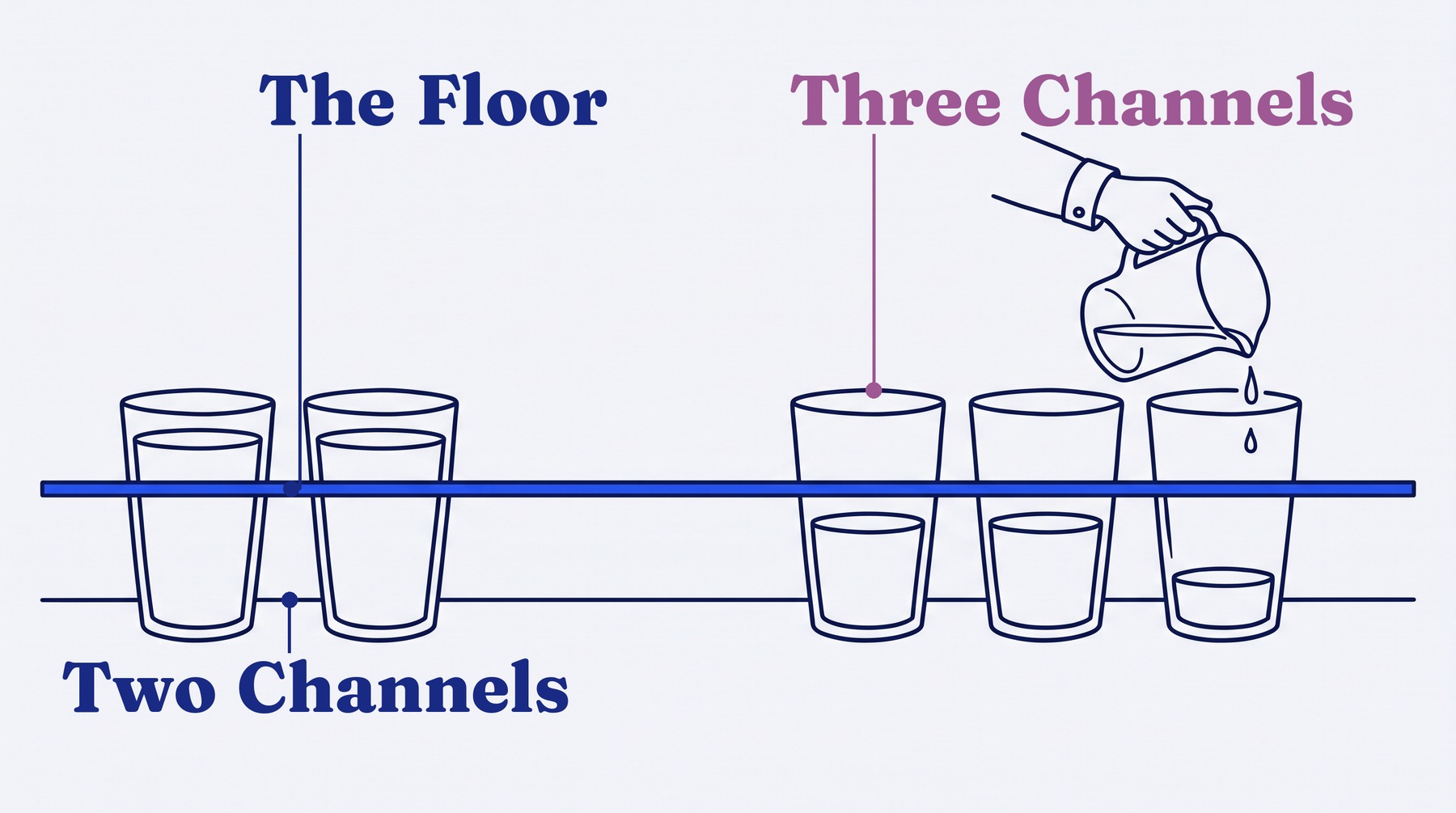
The rule running across that picture is the floor, and it does not move when the plan changes. One jug fills two glasses past it and leaves three of them short.
That sum is the entire capacity argument, and it fits on one line of a slide. Everything else in this lesson exists to make each of those three figures defensible when somebody asks where it came from.
Set the board to your own week
Hold the board up on the call. It shows the division instead of asking anybody to take your word for it, off a calendar the client can open themselves.
Set the board below to your own week. Switch a channel between primary and secondary and watch the remainder move.
Flipping one channel to secondary drops its need to a single asset a week, and the whole board clears without anybody working longer. That is the trade in lesson three, drawn as arithmetic rather than argued out loud.
What you do now
Read the board against your own week and count how many channels clear their floor.
Where these numbers come from
The six, the three, the two and the one are a worked example, chosen because they divide cleanly. None of them is a benchmark and none of them is a measurement taken from anybody's account. Your own week comes off your own calendar and your own floors come off eight weeks of your own history, which is why this lesson gives you the procedure rather than the figures. No claim here is a measured result about any tool, any agency or any client.